Building Stronger Students, Families & Communities Through Better Thinking
Born in Maryland. Built for Impact.
Maryland has always been a state of resilience, courage, innovation and reinvention. From Havre de Grace and the Chesapeake Bay to Baltimore and communities across the state, generations of Marylanders have demonstrated what can happen when people confront difficult circumstances with courage, knowledge and determination.
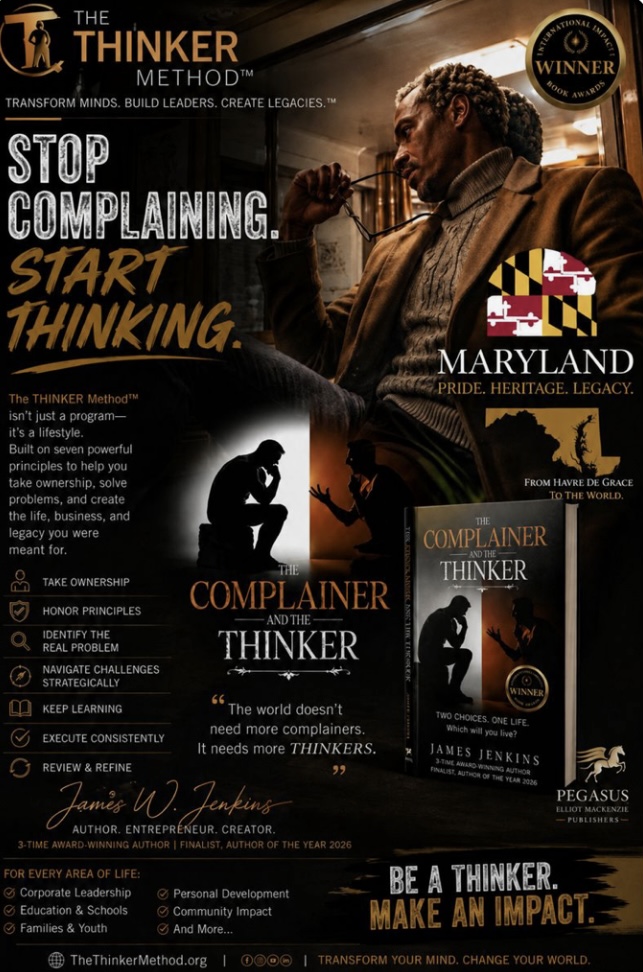
The Maryland THINKER Initiative™ seeks to carry that legacy forward by exploring how The THINKER Method™ can support students, families, educators and communities through practical principles of accountability, decision-making, problem-solving, leadership and personal development.
Our vision begins with Maryland—but the lessons are universal.
Transform Minds. Build Leaders. Create Legacies.™
Why Maryland? A Legacy of Resilience
Maryland’s history is filled with moments when ordinary people were confronted by extraordinary circumstances—and chose to move forward.
From the courage of the Maryland 400 during the American Revolution to the burning and rebuilding of Havre de Grace during the War of 1812, Maryland’s story has repeatedly demonstrated resilience under pressure.
That same conflict eventually reached Baltimore, where American forces defended Fort McHenry and the sight of the flag still flying after the bombardment inspired the words that became The Star-Spangled Banner.
Maryland was also home to transformative figures including Harriet Tubman, Frederick Douglass and Baltimore-born Thurgood Marshall—people whose lives demonstrated the power of courage, education, strategic thinking and determined action.
Even the battleship USS Maryland survived the attack on Pearl Harbor, was repaired and returned to service during World War II.
These stories span different centuries and very different circumstances, but they share an important lesson:
Difficult circumstances do not have to determine what happens next.
The Maryland THINKER Initiative™ seeks to bring that lesson into the present—helping a new generation understand Maryland’s history while developing the thinking, accountability and decision-making skills necessary to help shape its future.
Baltimore: Building Stronger Decisions Before the Moment of Crisis
Baltimore is a city of extraordinary history, culture, creativity and potential. It is also home to young people and families navigating challenges that cannot be solved by any single program, institution or policy.
The Maryland THINKER Initiative™ proposes a simple but important question:
What if we strengthen the thinking that happens before a life-changing decision is made?
Violence prevention cannot begin only after conflict has escalated. Young people also need practical opportunities to develop self-accountability, emotional awareness, problem-solving, communication, conflict-resolution and strategic decision-making skills before difficult moments occur.
Through The THINKER Method™, students would learn to slow down and work through seven principles:
T — Take Ownership
H — Honor Principles
I — Identify the Real Problem
N — Navigate Challenges Strategically
K — Keep Learning
E — Execute Consistently
R — Review & Refine
Imagine applying those principles to situations students actually encounter—an argument at school, a social-media conflict, peer pressure, academic failure, anger, bullying, retaliation or a disagreement that is beginning to escalate.
Instead of asking only, “Who started it?”, we begin teaching another question:
“What is the smartest thing I can do next?”
The goal is not to suggest that The THINKER Method™ alone can eliminate youth violence. Rather, the initiative seeks to complement educators, families, counselors, mentors, restorative-practice programs and established violence-prevention efforts with an additional framework for developing stronger decision-making and personal responsibility.
Baltimore’s young people should never be defined solely by the challenges surrounding them.
They should be recognized for their potential, intelligence, creativity and capacity to lead.
The Maryland THINKER Initiative™ is built around helping more young people recognize that capacity—and giving them practical tools to use it.
Families Are Part of the Solution
A student’s development does not begin when the school bell rings—and it does not end when the school day is over.
If we want to build stronger students and safer, more connected communities, families must be part of the conversation.
The Maryland THINKER Initiative™ envisions students, parents, guardians, educators and mentors sharing a common language for approaching challenges.
Imagine a young person hearing the same questions at school and at home:
What can you take ownership of?
What principle should guide your decision?
What is the real problem?
What is the smartest way to navigate this situation?
What did you learn?
What will you do differently next time?
These conversations can turn The THINKER Method™ from something taught in a classroom into something practiced in everyday life.
Family-focused resources could include discussion guides, parent and guardian workshops, at-home THINKER exercises, conflict-resolution activities and practical tools designed to strengthen communication between young people and the adults supporting them.
The purpose is not to tell families how to raise their children.
It is to give families additional tools for communication, accountability, problem-solving and growth.
One Student. One Family. One Community at a Time.
When students learn a principle at school, practice it at home and see it reinforced by mentors and community leaders, we begin doing more than teaching a curriculum.
We begin building a culture of THINKERS.™
And stronger families can become one of the foundations upon which stronger communities are built.
One Maryland: Urban, Suburban & Rural Communities
The Maryland THINKER Initiative™ is not a program for one neighborhood, one school system or one type of family.
It is a vision for Maryland.
Young people growing up in Baltimore City may encounter challenges different from students living in Harford County, Montgomery County, Prince George’s County, Western Maryland or on the Eastern Shore—but every young person will eventually face moments requiring judgment, accountability and difficult decisions.
Suburban communities are not immune to challenges.
Students may experience bullying, social-media conflict, academic pressure, isolation, peer pressure, family difficulties, substance-related pressures, uncertainty about their futures and the constant influence of an increasingly digital world.
Rural communities may confront different barriers, including limited access to certain resources, transportation challenges, economic transitions and fewer nearby support services.
The circumstances may change.
The need for strong thinking does not.
The THINKER Method™ is designed around principles that can cross geographic, economic and cultural boundaries:
Take responsibility for what you can control.
Develop principles strong enough to guide difficult decisions.
Identify problems before reacting to them.
Navigate challenges strategically instead of impulsively.
Continue learning from both success and failure.
Practice positive decisions consistently.
Review your actions and refine your approach.
These are not “inner-city skills.”
They are life skills.
They belong in Baltimore.
They belong in Havre de Grace.
They belong in suburban Maryland.
They belong on the Eastern Shore and in Western Maryland.
They belong in classrooms, homes, youth organizations, workforce programs and communities throughout the state.
Different Communities. Shared Principles. One Maryland.
The long-term vision of the Maryland THINKER Initiative™ is to create an adaptable framework that respects the identity and needs of individual communities while providing a shared foundation of leadership, accountability, communication, resilience and strategic problem-solving.
Because Maryland’s future will not be built by one county or one city.
It will be built together.
The Maryland THINKER Pilot Program
Big ideas become meaningful when they can be tested, measured and improved.
Rather than beginning with a large statewide rollout, the Maryland THINKER Initiative™ proposes a responsible first step:
Start Small. Measure Honestly. Learn. Improve. Expand What Works.
A Maryland THINKER Pilot could begin with a select group of participating schools, youth organizations or community programs working voluntarily with educators, families and community partners.
The pilot would introduce students to the seven principles of The THINKER Method™ through age-appropriate lessons, discussions, real-life scenarios, reflection exercises and practical decision-making activities.
What Could Students Practice?
Students could work through situations they may actually encounter:
A disagreement is escalating. What happens next?
Someone insults you online. Do you react—or think first?
Peer pressure is pushing you toward a decision you know is wrong. How do you navigate it?
You failed an assignment or made a serious mistake. Do you blame someone—or identify what you can control next?
Someone challenges your pride in front of other people. What response protects both your future and your dignity?
These moments allow students to practice THINKER principles before encountering similar decisions in real life.
Include the Entire Support System
A meaningful pilot should not focus only on students.
Where appropriate, it could include:
Students — structured THINKER lessons and activities.
Educators — practical tools for reinforcing THINKER language and decision-making.
Families — optional resources and workshops that allow principles learned at school to continue at home.
Community Partners & Mentors — additional reinforcement outside the classroom.
The objective is to create consistency without replacing the professional roles of teachers, counselors, social workers, mental-health professionals or established violence-prevention organizations.
The THINKER Method™ would be designed to work alongside them.
Measure What Matters
The initiative should be willing to prove its value.
Before and after an appropriately designed pilot, participating schools and qualified evaluation partners could examine measurable indicators such as:
- Student understanding of conflict-resolution and decision-making strategies
- School connectedness and sense of belonging
- Classroom engagement
- Attendance patterns
- Disciplinary referrals and behavioral incidents
- Student self-reflection and problem-solving skills
- Family participation and feedback
- Educator observations and feedback
- Student perceptions of their ability to respond constructively to conflict
Any evaluation should account for privacy, appropriate consent, school policies and sound research practices.
Most importantly:
We Follow the Evidence.
If something works, strengthen it.
If something does not work, change it.
If students tell us something is missing, listen.
If educators identify a better approach, learn from them.
If the evidence supports expansion, build responsibly.
That is not a weakness in the program.
It is the THINKER Method™ in action.
Review & Refine™
The final principle of The THINKER Method™ may become one of the most important principles of the entire Maryland initiative:
R — Review & Refine.
We should never ask students to examine their decisions while refusing to examine our own program.
The Maryland THINKER Initiative™ should remain accountable to the same principles it teaches.
Our goal is not simply to put another program into Maryland schools.
Our goal is to discover what genuinely helps young people think better, choose better and build stronger futures.
And if Maryland can demonstrate that these principles contribute meaningfully to student development, family engagement and healthier school communities, the lessons learned from a carefully evaluated pilot could help guide responsible expansion throughout the state—and potentially beyond it.
Maryland History Comes Alive in the Classroom
Maryland’s history should be more than names, dates and events students memorize for a test.
It can become a classroom for life.
The Maryland THINKER Initiative™ envisions connecting the seven principles of The THINKER Method™ with real people, places and turning points from Maryland history—allowing students to examine not only what happened, but also the decisions, principles and perseverance behind what happened next.
T — Take Ownership
Maryland’s history provides countless opportunities to examine responsibility and leadership.
Students can study the decisions made by Marylanders during moments of war, social change and community rebuilding and ask:
What could these individuals control?
What responsibilities did they accept?
What happens when we take responsibility for our next decision—even when we did not create the circumstances surrounding us?
This transforms accountability from a lecture into a conversation.
H — Honor Principles
Harriet Tubman and the Courage to Stand for Something
Born enslaved on Maryland’s Eastern Shore, Harriet Tubman escaped slavery and then repeatedly risked her freedom and safety to help others pursue theirs.
Students can examine more than Tubman’s extraordinary accomplishments.
They can examine her principles.
What makes someone continue doing what they believe is right when doing so involves tremendous risk?
Tubman’s life provides a powerful opportunity to discuss courage, service, leadership and commitment to something larger than oneself.
I — Identify the Real Problem
Frederick Douglass and the Power of Education
Frederick Douglass was born enslaved on Maryland’s Eastern Shore and spent formative years in Baltimore.
His journey toward literacy helped transform his understanding of slavery, freedom and his own possibilities.
Students can explore an important THINKER question:
What happens when we learn to identify the deeper problem instead of reacting only to what we see on the surface?
Douglass ultimately used learning, writing and public speaking to challenge an institution much larger than himself.
His life demonstrates that education is not simply about passing examinations.
Knowledge can become power when we learn how to use it.
N — Navigate Challenges Strategically
Thurgood Marshall and Changing America Through Strategy
Baltimore-born Thurgood Marshall encountered segregation firsthand.
He eventually became an attorney who helped challenge segregation through the American legal system and later became the first African American justice of the United States Supreme Court.
Marshall’s journey offers students an extraordinary lesson in strategy.
He confronted injustice, but his response required preparation, education, discipline, evidence and an understanding of the system he intended to change.
Students can ask:
When confronted with something wrong, what is the most effective way to respond?
Sometimes courage means standing up.
Sometimes courage means preparing.
And sometimes the most powerful response is a strategy built patiently over time.
K — Keep Learning
Maryland’s Tradition of Innovation
Maryland has long contributed to transportation, science, medicine, defense, education and technological development.
The Baltimore & Ohio Railroad helped transform American transportation.
Aberdeen Proving Ground became an important center of military testing, research and technological development.
Maryland’s universities, research institutions, medical centers, military facilities, businesses and entrepreneurs continue that tradition today.
Students should see themselves as potential contributors to the next chapter.
The next Maryland innovation may already exist in the imagination of a student sitting in a classroom today.
E — Execute Consistently
Fort McHenry and Standing Through the Night
During the War of 1812, British forces bombarded Fort McHenry as they attempted to capture Baltimore.
The fort held.
The sight of the American flag still flying afterward inspired Francis Scott Key to write the words that eventually became The Star-Spangled Banner.
Students can examine the difference between wanting to persevere and actually continuing through difficulty.
Goals require more than intention.
They require consistent action.
The lesson can then become personal:
What are you willing to keep working toward when progress becomes difficult?
R — Review & Refine
Havre de Grace: Rebuilding After Destruction
In 1813, British forces attacked Havre de Grace during the War of 1812, burning much of the town.
But the community survived.
It rebuilt.
That history creates a powerful final THINKER lesson.
Reviewing what happened does not mean living permanently in the past.
It means learning from the past so that we can build differently in the future.
Students can be taught to ask:
What happened?
What did I learn?
What should I keep?
What needs to change?
What will I do next?
USS Maryland — Hit, But Not Finished
Maryland’s history offers another unforgettable illustration of resilience.
USS Maryland was present during the Japanese attack on Pearl Harbor on December 7, 1941.
The battleship survived the attack, underwent repairs and returned to service during World War II.
For students facing setbacks, the lesson does not need to glorify war.
The lesson is about recovery:
Being hit does not mean being finished.
Failure does not have to be final.
A difficult childhood does not automatically determine adulthood.
A bad grade does not determine intelligence.
A mistake does not have to determine identity.
A conflict does not have to determine tomorrow.
What matters tremendously is what happens next.
From Memorizing History to Learning From It
Imagine Maryland students completing a history lesson and being asked something different from the traditional final question.
Not simply:
“What year did this happen?”
But also:
“What can this teach you about your life?”
What can Harriet Tubman teach us about principles?
What can Frederick Douglass teach us about learning?
What can Thurgood Marshall teach us about strategy?
What can Fort McHenry teach us about perseverance?
What can Havre de Grace teach us about rebuilding?
What can USS Maryland teach us about recovering after being hit?
History then becomes more than something behind us.
History becomes a tool for building what comes next.
The Maryland THINKER Initiative™ seeks to help students understand that they are not disconnected from Maryland’s story.
They are its next authors.
The question is not whether Maryland’s history will continue.
It will.
The question we should place before every young Marylander is:
What Will Your Chapter Say?
From the Classroom to Careers & the Workforce
Education should prepare young people not only to pass a test—but to navigate life after the classroom.
Maryland’s students will become tomorrow’s employees, skilled tradespeople, entrepreneurs, educators, healthcare professionals, engineers, public servants, military personnel, business owners and community leaders.
Employers may teach someone how to perform a job.
Schools may teach academic knowledge.
Technical programs may teach a trade.
But young people also need the personal and professional skills that help them successfully apply what they have learned.
Knowledge Opens the Door. Character Helps You Stay in the Room.
The Maryland THINKER Initiative™ seeks to strengthen qualities that can follow students from the classroom into adulthood:
Accountability.
Communication.
Problem-solving.
Adaptability.
Strategic thinking.
Consistency.
Leadership.
The ability to learn from mistakes.
These are not skills reserved for executives.
They matter to the apprentice arriving for work on Monday morning.
They matter to the college student managing new responsibilities.
They matter to the young entrepreneur trying to build a business.
They matter to the employee receiving difficult feedback.
They matter to the future manager responsible for leading a team.
And they matter to the young person deciding what direction to take when life does not unfold according to plan.
Creating a Bridge Between Education and Opportunity
The Maryland THINKER Initiative™ could eventually create opportunities for collaboration among participating schools, workforce-development organizations, community colleges, trade programs, universities, employers and community organizations.
Students could encounter professionals who demonstrate how THINKER principles appear in real life.
An employer can explain why Take Ownership matters in the workplace.
An entrepreneur can demonstrate Navigate Challenges Strategically.
A skilled tradesperson can show why Execute Consistently matters when quality and safety depend on doing a job correctly.
An educator can demonstrate Keep Learning.
A community leader can show how Honor Principles influences leadership.
And a successful professional can explain something every young person eventually discovers:
Your First Plan Will Not Always Work.
That is why Review & Refine matters.
A setback does not necessarily mean stop.
Sometimes it means:
Learn. Adjust. Try Again.
Multiple Roads Can Lead to Success
Not every Maryland student needs to follow the same path.
For one student, success may mean attending a four-year university.
For another, it may mean community college.
For another, an apprenticeship.
For another, military service.
For another, earning a commercial or technical license.
For another, entering healthcare, technology or public service.
And for another, it may mean starting a business and creating jobs for other Marylanders.
The Destination Is Not the Same for Everyone.
What should remain consistent is helping young people develop the ability to make thoughtful decisions about their futures.
Instead of asking every student:
“Are you going to college?”
We can also ask:
“What are you building?”
“What skills will you need?”
“What is your plan?”
“What obstacles could interfere with that plan?”
“Who can help you?”
“What will you do if Plan A fails?”
Those are THINKER questions.
From Violence Prevention to Opportunity Creation
Preventing harmful decisions is important.
But prevention alone is not enough.
Young people also need something meaningful to move toward.
A career.
A skill.
A business.
An education.
Financial independence.
Leadership.
A purpose.
A future they can imagine themselves participating in.
That is why the long-term vision of the Maryland THINKER Initiative™ extends beyond conflict resolution.
We Want Young People Thinking Beyond the Next Moment and Toward the Next Decade.
When a student begins to see a future worth protecting, today’s decisions can take on new meaning.
Maryland Businesses Can Become Part of the Mission
Maryland’s business community could have an important role in this effort.
Potential partnerships could eventually include:
Career speakers and mentors
Workplace tours and career exposure
Internship and apprenticeship pathways
Entrepreneurship education
Workforce-readiness workshops
Program sponsorship
Educational materials and technology support
Scholarship opportunities
Community investment
Businesses would not simply be asked to donate.
They could become partners in developing Maryland’s future workforce.
Because the student sitting in a Maryland classroom today may become the employee, entrepreneur, customer, innovator or business leader Maryland depends upon tomorrow.
Build Students Today. Build Maryland Tomorrow.
The Maryland THINKER Initiative™ is ultimately about more than helping young people avoid poor decisions.
It is about helping them become capable of making great ones.
Great decisions about education.
Great decisions about relationships.
Great decisions about careers.
Great decisions during conflict.
Great decisions about money.
Great decisions about leadership.
Great decisions about their futures.
From Baltimore City to Havre de Grace, from Maryland’s suburbs to its rural communities, our young people should understand something powerful:
Your ZIP Code May Describe Where You Started.
It Does Not Have to Decide Where You Finish.
Give young people knowledge.
Give them opportunity.
Give them expectations.
Give them people who believe in their potential.
And give them a framework for thinking through the decisions standing between where they are and where they want to go.
That is how students become leaders.
That is how families become stronger.
That is how communities move forward.
And that is how Maryland invests in what comes next.
Partner With the Maryland THINKER Initiative™
Maryland’s next chapter will not be written by one person, one school, one organization or one program.
It Will Take Partnership.
The Maryland THINKER Initiative™ is seeking conversations with educators, schools, families, community organizations, businesses, foundations, workforce-development leaders, universities, researchers and other Maryland stakeholders interested in helping young people build stronger decision-making, leadership and life skills.
This initiative begins with an idea—but the goal is to build something that can be tested, measured, improved and strengthened through collaboration.
Schools & Educators
We welcome conversations with educators and school leaders interested in exploring a potential THINKER pilot.
Educators can help ensure that materials are age-appropriate, practical and responsive to the realities students and teachers experience every day.
Their voices should help shape the program—not simply receive it.
Parents & Families
Families are essential partners.
The initiative seeks to develop practical resources that help parents and guardians reinforce accountability, communication, conflict resolution and thoughtful decision-making at home.
When schools and families share constructive language, students receive a more consistent message:
Think Before the Decision. Learn After the Decision. Keep Moving Forward.
Community & Youth Organizations
Mentoring organizations, recreation programs, faith-based organizations, youth centers and community leaders can help bring these principles beyond the classroom.
Community partners also understand their neighborhoods in ways an outside program never could.
We want to listen before we lead.
Maryland Businesses & Employers
Businesses can help Maryland’s young people understand how today’s decisions connect to tomorrow’s opportunities.
Potential involvement could include mentorship, career exposure, internships, apprenticeships, entrepreneurship education, program sponsorship, educational resources and workforce-readiness partnerships.
Supporting students today is also an investment in Maryland’s future workforce.
Universities & Research Partners
Credibility requires more than good intentions.
The Maryland THINKER Initiative™ welcomes conversations with universities, researchers and qualified evaluation partners interested in helping design responsible methods for measuring outcomes.
We want to know:
What works?
What needs improvement?
What are students actually learning?
Are families seeing meaningful changes?
Are participating schools experiencing measurable benefits?
And if the evidence does not support an assumption, we should be willing to change it.
Review & Refine™ applies to us too.
Foundations, Sponsors & Funding Partners
Developing quality curriculum, student workbooks, family resources, educator materials, facilitator training, digital resources and independent program evaluation requires investment.
The Maryland THINKER Initiative™ welcomes responsible funding and sponsorship conversations with organizations that share the goal of strengthening young people, families, education and Maryland communities.
Support could help fund:
Curriculum development
Student and family materials
Pilot implementation
Educator and facilitator resources
Program evaluation and research
Technology and digital learning resources
Community workshops
Career and workforce-development programming
The objective is not simply to fund another program.
The Objective Is to Build Something Worth Funding.
Something measurable.
Something accountable.
Something educators can help improve.
Something families can use.
Something students can carry with them beyond the classroom.
Maryland, Let’s Build What Comes Next.
From the Maryland 400 to Havre de Grace.
From Fort McHenry to Baltimore.
From Harriet Tubman and Frederick Douglass to Thurgood Marshall.
From the Chesapeake Bay to communities across our state, Maryland’s history reminds us that difficult circumstances have never prevented Marylanders from building what comes next.
Now we have another generation preparing to write its chapter.
Let’s Give Them More Than Advice.
Let’s give them tools.
Let’s teach accountability without destroying confidence.
Let’s teach leadership without arrogance.
Let’s teach young people to identify problems before reacting to them.
Let’s strengthen communication between students, families and communities.
Let’s connect education with careers and opportunity.
Let’s measure our results.
Let’s learn from what doesn’t work.
And let’s expand what does.
The Maryland THINKER Initiative™ is ready to begin that conversation.
Schools. Families. Communities. Businesses. One Maryland.
Transform Minds. Build Leaders. Create Legacies.™
BE A THINKER. MAKE AN IMPACT.
Interested in becoming a partner, supporting a pilot or learning more?